The Story of The Volunteers….
Volstalgia: How Blood, Land, and a Hell of a Grudge Built the Tennessee Volunteers
Every Saturday in the fall, over one hundred thousand fans, bathed in radiant checkerboard orange, packed Neyland Stadium to scream their lungs out, “GO VOLS.”
Most folks assume the nickname is just a nod to polite civic duty or military service. But long before it was a rallying cry at The University of Tennessee, "Volunteer" was forged through a volatile mix of economic hardship in America, sensational newspaper ink, raw political defiance, and a desperate fight to defend freedom across the Rio Grande.
To understand why thousands of Tennesseans laid down their plows, gripped their long rifles, and set out for Texas in the 1830s, you have to look at the financial wreck at home. The frontier was sliding into a brutal downturn. Banks failed, foreclosures swept small towns, and debts piled sky-high. For a young frontiersman staring down an empty ledger, the future looked bleak.
Then came the sales pitch.
Across the border in the Mexican territory of Coahuila y Tejas, an immense expanse was opening up. Word spread that east of a frontier lay a "Garden of Eden"—vast, rich bottomland practically being handed away. Even better, the revolutionary Texas government sweetened the deal with a jaw-dropping bounty for anyone game enough to take on Mexican General Antonio López de Santa Anna:
Enlist for three months, walk away with 320 acres.
Enlist for a year, pocket 1,280 acres of prime dirt.
For a broke Tennessean, Texas wasn’t just a crusade for liberty. It was a fresh start.
The Megaphone: George Childress
Enter George Childress. A sharp Nashville lawyer and editor of the Nashville Banner, Childress didn’t command an army, but his printing press fired just as loudly. Deeply tied to the Texas colonization effort, he framed the southwestern rebellion as a natural continuation of 1776. This wasn’t a land grab, he insisted—it was a battle against tyranny for brothers who were being denied juries, fair representation, and basic freedoms.
Childress took the pitch directly to public halls in lively "Texas Meetings." He broke down the legal land incentives, stirred the room, and reminded everyone that native sons Sam Houston and Davy Crockett were already in the thick of it. And if Andrew Jackson discreetly nodded in approval from the White House, what red-blooded Tennessean was going to stay sitting on his hands?
The Feud: Crockett vs. Jackson
While Childress built the recruitment pipeline, the state’s favorite son packed his bags out of sheer political disgust.
Davy Crockett had carved his legend alongside Andrew Jackson in the Creek War, rising together from the rough-and-tumble frontier to Capitol Hill. But in Washington, their path split hard over a question of conscience.
The fracture point was Jackson’s Indian Removal Act of 1830. Jackson expected blind loyalty from his delegation to strip Native nations—including the Cherokee—of their ancestral lands and force them westward on what became the Trail of Tears. Crockett flatly refused. Standing in the House chamber, he defied his own party, calling the act an outrage against humanity and treaties alike:
"I would sooner be honestly and politically damned than hypocritically immortalized."
Crockett also championed land rights for poor frontier squatters, while Jackson’s machine backed wealthy speculators. Jackson neither forgot nor forgave the defiance. His political allies targeted Crockett, orchestrating his congressional defeat in 1835.
Disillusioned, bitter, and done with the establishment, Crockett dropped his legendary parting shot on his constituents: "You may all go to hell, and I will go to fight in Texas."
The Alamo & The Price Paid
Crockett crossed into Texas in early 1836, leading his crack-shot "Tennessee Mounted Volunteers." When they rode into the Alamo mission in San Antonio that February, spirits soared. Davy waved off any grand officer title; he stood shoulder-to-shoulder as a simple private.
During the thirteen-day siege, Crockett kept the compound alive. Stationed along the wooden palisade on the exposed southeastern front, his riflemen picked off enemy artillery crews with impossible precision. When relentless midnight shellings rattled the garrison, Davy hauled out his fiddle, swapping tunes and tall tales with a Scottish bagpiper to drown out the tension. When Santa Anna's forces finally overran the walls at dawn on March 6, Crockett and his volunteers met them with everything left, swinging empty rifles like clubs and driving home hunting knives until the end.
While Crockett wrote history in blood, George Childress penned it in ink. Days before the Alamo fell, Childress sat in a draft-swept wooden hall at Washington-on-the-Brazos. Modeling his hero Thomas Jefferson, he drafted the Texas Declaration of Independence virtually single-handedly in one day.
Yet Childress never tasted the spoils of the republic he minted. Broke from bankrolling his own travels, he failed at three subsequent legal ventures in Houston and Galveston amid hyperinflation. Penniless, suffering a severe breakdown, and desperate to spare his estranged family further destitution, Childress took his own life in 1841 with a Bowie knife. He was buried in an unmarked Galveston grave whose exact location remains lost to time.
The Name Sticks: The Volunteer State
A decade after the Alamo, the legacy of that frontier drive boiled over. In 1846, the Mexican-American War began. President James K. Polk—himself a former governor of Tennessee—called for 2,800 soldiers from his home state.
Around 30,000 men showed up to enlist.
They overwhelmed the recruiting offices, ready to honor the grit of Crockett and the legends who came before them. From that day on, newspapers nationwide knew the territory by one undisputed title: The Volunteer State.
When UT fielded its inaugural football squad in 1891, the roster went simply by "The Tennesseans" or "The Varsity." The turning point came in Atlanta on November 22, 1902, when Tennessee gutted out an upset 10–6 victory over Georgia Tech. The Atlanta Constitution splashed a headline heralding the visitors' resolve, dubbing them "The Volunteers." By 1905, the university officially claimed the name.
Hounds, Hazes, and Coonskin Caps
For decades, nobody could quite agree on how to depict a Volunteer. By the 1930s, cartoonists leaned into frontier imagery: fringed buckskins, a trusty flintlock, and a coonskin cap. Crockett’s silhouette became the natural standard.
Then came the coon dog.
In the fall of 1953, the UT Pep Club held a contest to find a live mascot—specifically, a blue-tick coonhound with real mountain bona fides. At halftime against Mississippi State that September, candidates paraded across the grass for a student clap-off.
The last dog up was "Brooks' Blue Smokey." When the announcer called his name, Smokey pointed his snout toward the sky and belted out an ear-splitting howl. The stadium went berserk, which only egged Smokey on to howl even louder. A staple of Appalachian hunting culture, the Bluetick Coonhound was bred for tireless endurance and an unyielding drive to track down game in the rugged mountains.
The hound's name also honored the nearby Great Smoky Mountains—a range known for the distinct blue-gray haze rolling over the ridges. Long before settlers arrived, the Cherokee called these peaks Shaconage ("place of the blue smoke"). That mist isn't smoke at all: the dense conifer forests exhale natural terpenes that react with humid air to scatter sunlight across the blue spectrum, naturally cooling the trees and giving the landscape its iconic shroud.
With the dog's name and the symbolic and enduring howl combined, it was a no-brainer; the vote to make Smoky UT’s mascot was overwhelming.
The Vols would also eventually keep Davy Crockett's history alive through the second mascot. In 1954, Walt Disney's Davy Crockett miniseries became a national obsession, permanently fusing the frontier aesthetic with Tennessee culture. The spirit grew into the famed 1970s "Rifleman" logo—a fierce, forward-leaning woodsman that remains an iconic vintage badge. By the 1990s, UT made Davy Crockett an unmasked, official student spirit tradition, bucking the trend of cartoonish foam-head mascots in favor of authentic buckskin and frontier pageantry.
The River Settlement: Who Owns the interlocking "UT"?
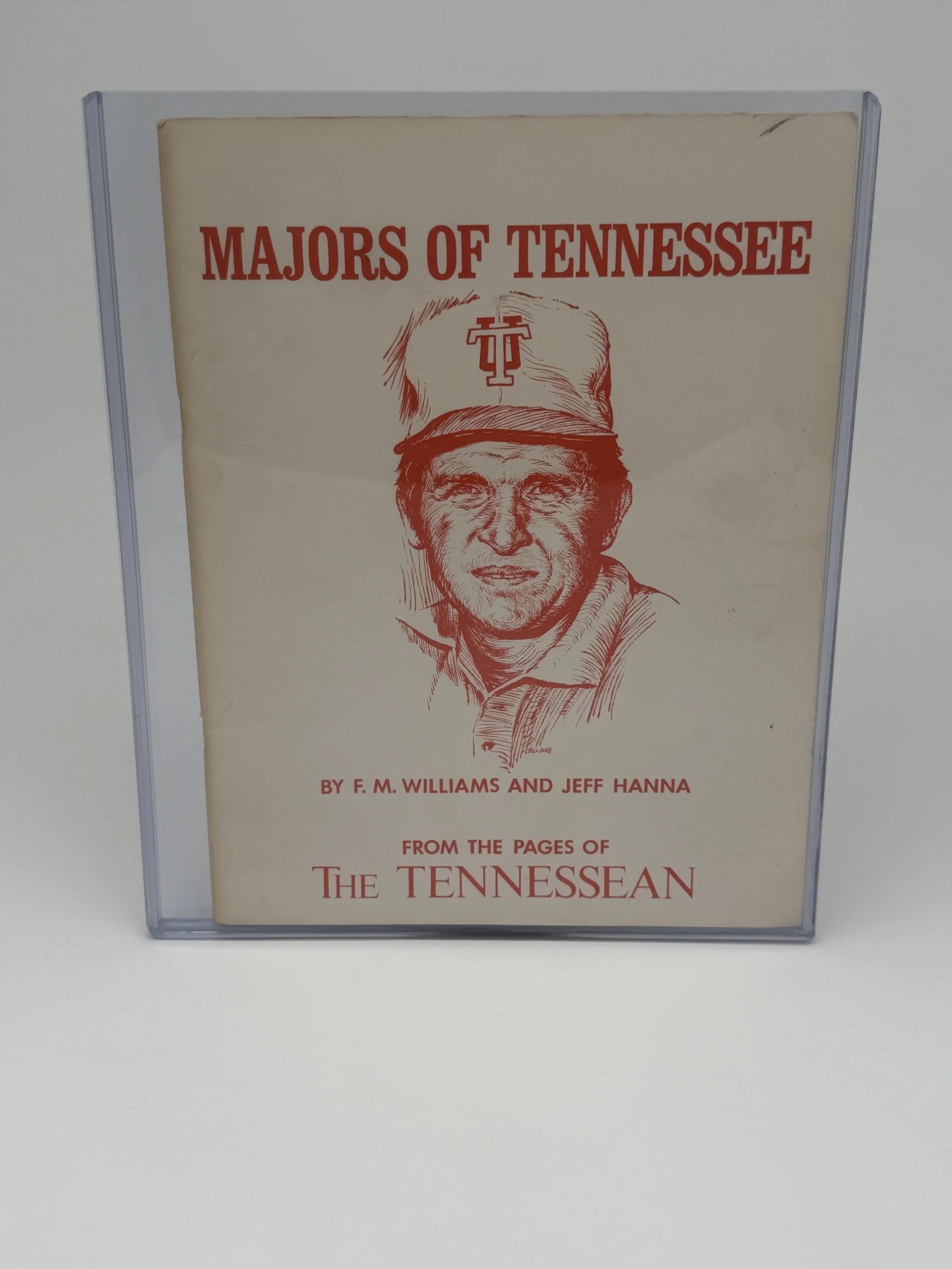
On the uniform front, early squads stuck to clean, minimalist striping and basic numbers. The famous block "T" arrived on the side of the football helmets in 1964 courtesy of head coach Doug Dickey. In 1977, Johnny Majors added weight and a signature, aggressive forward tilt to convey momentum, permanently minting the iconic "Power T."
Yet for decades, Tennessee also leaned heavily on the classic overlapping "UT" emblem, dating back to early 20th-century baseball caps.
Down in Austin, the University of Texas held a federal trademark on the interlocking "UT." But in the early 1980s, Tennessee filed for national retail rights to brand caps, apparel, and glassware with the same letters. Rather than burn stacks of cash in a drawn-out federal trademark war, the two universities struck a historic compromise in 1986.
They drew a line down the middle of the continent: the Mississippi River.
Under the pact, Tennessee secured exclusive commercial rights to the interlocking "UT" everywhere east of the Mississippi, while Texas held the rights west of it. Naturally, Tennessee’s legal team baked in an ingenious carve-out for West Baton Rouge Parish, ensuring traveling fans could pick up gear on their way into Tiger Stadium.
From 1836 to the modern gridiron, the Lone Star State owes much of its story to the men who rode out from our hills. So whenever you spot those interlocking letters or see the orange and white take the field against our old burnt-orange neighbors, remember which UT was here first and answered the calls to save your proud Texas asses. Go Vols!
Volstalgia
It All Begins Here
As collectors ourselves, we often value a collection not on strict market value and advanced analytics, but what it means to us personally. I will share my personal collection here, along with the stories that go with it. To us, this is what collecting is about: enjoying the gift of great memories, talking about legends from life, learning from shared history, and sharing that with others. #GBO